
Let’s be honest. When you hear the words bodyweight training workout, perhaps a part of your brain dismisses it as something you do on vacation, or maybe something you do to “get started.” I know many guys who feel that if they aren’t loading up a barbell with heavy plates, they just aren’t getting a real workout. It is an understandable feeling, particularly if you have spent years in a traditional gym environment.
The truth is, for many of us, life just gets busier. Maybe the time you had for a two-hour gym session with a commute is gone, replaced by work, family, or other commitments. We still want the results strength, functional fitness, and the ability to move well but we are short on time and gear. This is where the old mentality needs a refresh. Bodyweight training isn’t just a placeholder until you get back to the gym; it is a serious, highly effective tool when you use it correctly.
You do not actually need massive external weight to break down muscle fibers. The human body is, you know, heavy enough to challenge itself, provided you understand how to manipulate a few key factors: tension, effort, and leverage. We are going to dig into the details that make the difference between doing a few random squats and performing a bodyweight training workout that actually forces your body to grow stronger, faster, and more coordinated.
We need to get past the generic lists of exercises that you see everywhere. Sure, you can list a squat or a push-up, but unless you know how to make that squat hard enough on Week 8 to challenge your legs, or how to progress that push-up so you don’t feel shoulder pain, the routine is going to fail. We will look at how to scale movements up and down, and how to structure a routine that crushes your cardiovascular system and builds muscle in just 20 minutes.
The Science of Effort: Why Tension Matters More Than Weight
If you want to build muscle, you must create a high level of effort. That effort is usually measured by how close you push the muscle to fatigue. In the gym, this is easy: you just add more weight. With a bodyweight training workout, you have to get smarter.
The key is Time Under Tension (TUT). This is how long the muscle is actively working during a set. If you drop into a squat quickly and spring back up, the time under tension is low. If you take four slow seconds to lower into the squat (the eccentric phase) and two seconds to stand up, you have multiplied the TUT, increasing the time the muscle is fighting the resistance. This is extremely effective for muscle growth and is one of the quickest ways to make a familiar movement feel completely new and brutally hard.
Bodyweight movements also offer an enormous hidden benefit: they build functional strength and coordination. When you perform a push-up, you aren’t just working your chest; you are stabilizing your entire core, triceps, and shoulders simultaneously. This holistic approach improves muscle synergy, helping you move better in everyday life whether you are moving furniture or just carrying heavy groceries. It is the type of strength that makes life easier, not just the kind that looks good in a mirror.
The Great Weakness: Fixing Your Bodyweight Pull
The biggest, most frustrating gap in any bodyweight training workout is the lack of a good pulling movement. Push-ups are easy. Squats are easy. But how do you train your back your lats, rhomboids, and traps without a pull-up bar? Many men overlook back training when they are only using bodyweight, which leads to muscle imbalances and that dreaded “forward slump” posture.
Training the posterior chain (the back of your body) is absolutely crucial for shoulder health and posture. If you can’t get to a pull-up bar, you have to use intelligent substitutions:
- The Superman: This exercise directly targets the lower back (erector spinae) and the traps in your upper back,. Lie face down, arms stretched out, and lift your arms, legs, and chest a few inches off the floor simultaneously. The movement should start with squeezing the glutes and back muscles. Hold the top for a count of five. This is a subtle movement, but it is one of the best ways to build spinal support without equipment.
- Reverse Snow Angels: This movement is excellent for the trapezius (upper back).5 Lie face down, lift your arms and chest slightly off the floor, and sweep your arms in an arc pattern behind you, as if you were making a snow angel on your stomach. The movement should be slow and controlled, focusing on squeezing the shoulder blades together as the arms move.
- Inverted Rows (Requires Setup): If you can find a sturdy, low-hanging bar (like a swing set bar or a sturdy table edge), the Inverted Row is the gold standard for bodyweight back training. Lie under the bar/table, grab it, and pull your chest up. The steeper your angle (the closer your body is to the floor), the harder it is. This is the closest you can get to a pull-up’s benefits without owning a bar.
The Progression Ladder: A Better Scaling System
The main reason people quit bodyweight training is stagnation. You can do 20 push-ups, then 30, and suddenly you are just doing high-rep cardio, not building strength. To fix this, you need a clear path to make the exercise harder, or easier, using nothing but leverage. This is called scaling.
Here is a detailed system for the three core movements. You should not move to Level 3 until you can perform at least 15 quality repetitions at Level 2 with perfect form.
The Push-Up (Upper Body Push)
Most articles tell you to do push-ups on your knees. That is fine, but the real key is managing the angle of your body.
| Level | Movement | Focus/How it Scales | Key Form Cue |
| Level 1 (Regression) | Wall or Incline Push-Up | Reduces the resistance against gravity. Use a kitchen counter or table for a lower incline, which is harder than a wall. | Keep your elbows tucked at a 45-degree angle to your body. Do not let them flare out like a “T.” |
| Level 2 (Foundation) | Kneeling or Full Push-Up (On Toes) | Builds volume and strength endurance. For kneeling, keep a straight line from your head to your knees. | Maintain a “plank position” with your core tight. Your body should move as one unit, not bending at the hips. |
| Level 3 (Progression) | Decline Push-Up (Feet elevated on a chair) or Hand Release Push-Up | Increases the load on the chest and shoulders by shifting more weight onto the upper body. | Focus on the Time Under Tension: Lower for 3 seconds, pause at the bottom, and drive up quickly. |
The Squat (Lower Body Strength)
The squat is your lower body workhorse. It builds the massive, calorie-burning muscles in your legs and glutes.
| Level | Movement | Focus/How it Scales | Key Form Cue |
| Level 1 (Regression) | Box or Chair Squat | Provides a target to ensure you hit depth consistently. You remove the fear of falling and perfect the movement pattern. | Initiate the movement by pushing your hips back, as if reaching for the chair. Keep your chest up tall. |
| Level 2 (Foundation) | Air Squat (Controlled Tempo) | Focus on moving through a full, unassisted range of motion. | Knee Tracking: Make sure your knees track out over the middle of your feet. Do not let them collapse inward. |
| Level 3 (Progression) | Jump Squat or Pistol Squat Regression | Adds explosive power (Jump Squat) or uses leverage to dramatically increase load (Pistol Squat/Single-Leg). | Drive through your heels to push back up. For the Jump Squat, land softly to absorb the impact. |
The 20-Minute Density Bodyweight Training Workout
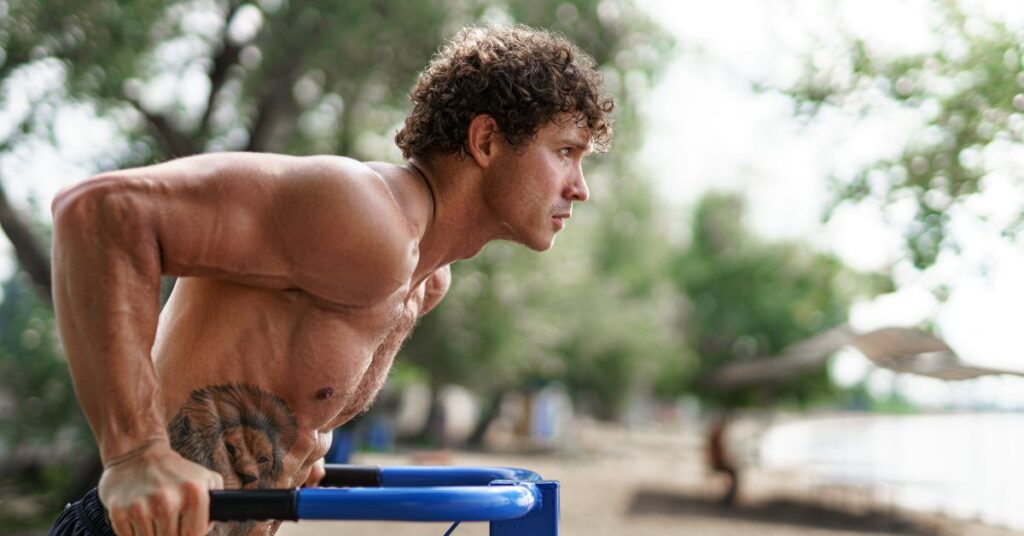
Instead of a basic “do three sets of 10 reps,” we are going to use a density training format called AMRAP (As Many Rounds As Possible). This keeps the intensity high, minimizes rest, and guarantees you do more work in the same amount of time than a traditional set/rep routine. This is the gold standard for fitting a massive workout into a small window.
Warm-Up (5 Minutes)
Do not skip this part. It is how you prevent injury and prime your body.
- Arm Circles (30 seconds forward, 30 seconds backward).
- Bodyweight Good Mornings (Hinge at the hips, hands behind the head, 60 seconds).
- Jumping Jacks or High Knees (2 minutes of light movement).
The AMRAP Bodyweight Training Workout (15 Minutes)
Set a timer for 15 minutes. Complete the following four exercises in the order listed, resting only as needed to maintain good form. Your score is the total number of complete rounds you finish in 15 minutes.
| Exercise | Repetition Count | Scaling Note | Intensity Goal |
| Push-Up | 10 Reps | Use your appropriate level (Level 2 recommended). | Focus on a 2-second lowering phase (TUT). |
| Reverse Lunge | 10 Reps per leg (20 total) | Use the reverse lunge for knee stability. | Go for full depth; make sure the back knee almost touches the floor. |
| Forearm Plank | 45 Seconds Hold | Do not let the hips sag or arch up. Squeeze the glutes. | This is your active “rest” maintain rigidity and control. |
| Mountain Climbers | 30 Reps (15 per leg) | Keep your hips low and use your core to drive the knees toward your chest.4 | This is your cardiovascular burst. Move quickly but with control. |
- Rest: Take as little rest as possible between exercises and rounds. Maybe a quick sip of water, then immediately start the next round. This intensity is how you build muscle and endurance quickly.
FAQs: Real Talk About Bodyweight Strength
A: Yes, absolutely, you should stop. When you are doing an intense routine like the AMRAP, form is the first thing to go when fatigue hits. You might find your back starts arching during the plank, or your knees wobble during the squat. Poor form is how people get hurt, and it also means the targeted muscles are no longer getting the benefit. It is much better to take a 10-second breather, reset your position, and finish the set with solid technique, than it is to grind out sloppy reps. Remember, the goal is quality movement, always
A: Bodyweight training can take you very far, but it does hit a ceiling for absolute maximum muscle growth (hypertrophy). Once you can perform the highest progression of a push-up (e.g., a Decline Push-Up) for high repetitions (15-20 reps) with excellent form, continuing to add more reps offers diminishing returns for sheer strength and size. At this point, you will likely need to introduce some external resistance maybe resistance bands, a weighted vest, or dumbbells to continue pushing the progressive overload principle. Bodyweight is not a failure; it is a phenomenal foundation that prepares your joints and tendons to safely handle heavy external loads later on.
A: You are probably right. Bodyweight exercises often force you to use smaller stabilizer muscles that traditional machines hold steady for you. When you do a Pistol Squat or a Single-Leg Deadlift, all those small muscles around your knee and hip have to work overtime to keep you balanced. This is a good thing! It translates into more balanced, injury-resistant, functional strength. You might feel a different kind of fatigue than after heavy weights, perhaps more “twitchy” or focused, and that is normal.
Leave a Reply